Sunday, May 28, 2023

Talking Mushrooms with Brent Cox from Frosty Hollow Mushrooms


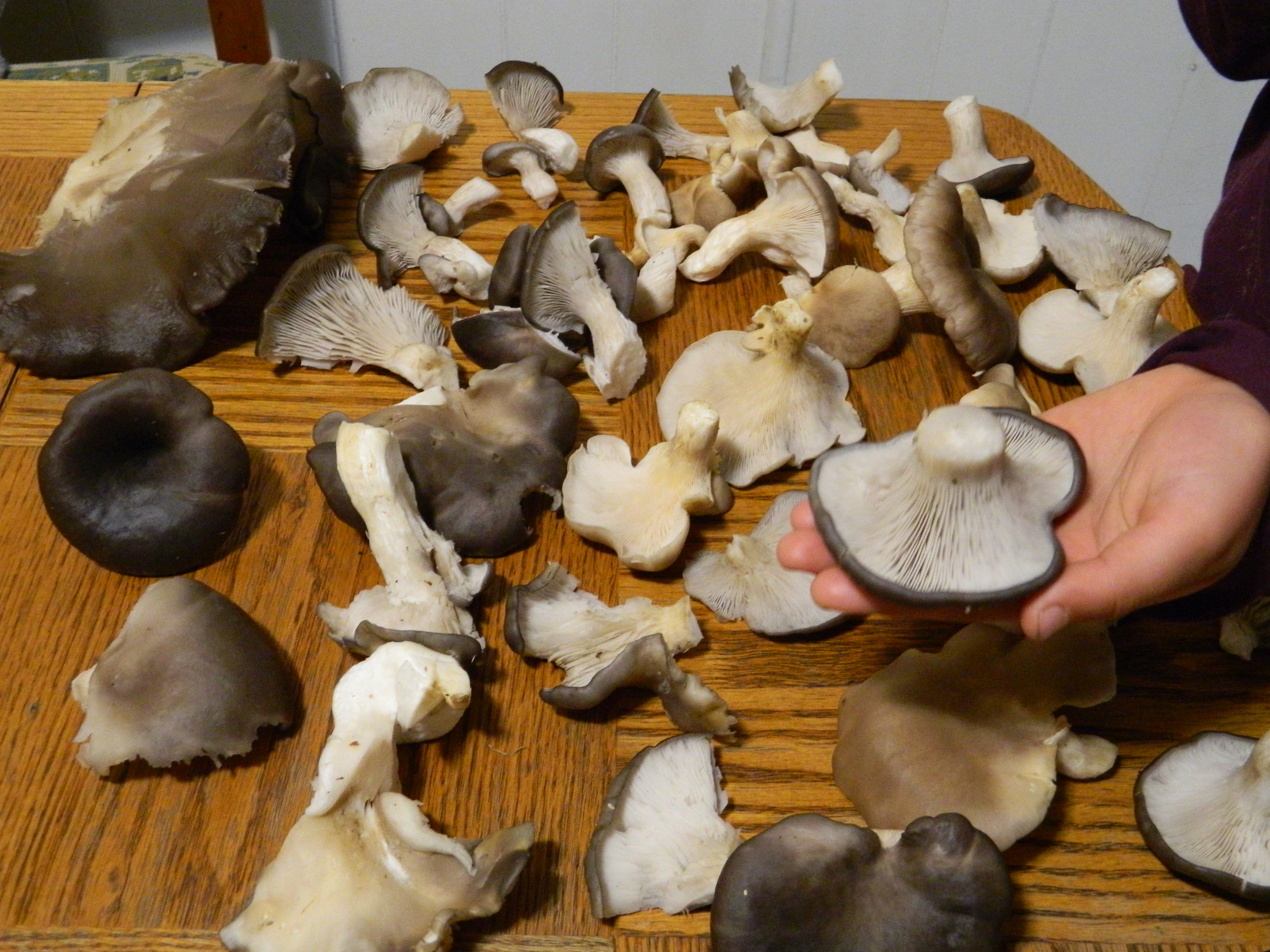
Recently my husband, Peter, took a grow-your-own-culinary-mushroom course with Brent Cox from Frosty Hollow Mushrooms. Since then, he has been slightly obsessed with growing mushrooms. We now have a patch of gourmet mushrooms growing in our forest. I love it! It is such a joy to watch the mushrooms grow from little nuggets to giant oysters.


Peter bought a bunch of mushroom compost from Lake Country Mushrooms and placed it in a shady spot in the forest and covered it up with hay. After the occasional watering we soon had the patch producing large, luscious patches of oyster mushrooms in varying colours. 

We are now eating mushrooms almost daily and we both cook and dry the mushrooms to preserve them for later. Countertops filled with mushrooms has become a common occurrence and the kids have been studying mushrooms as part of their homeschooling.


golden oyster mushrooms top
elm oyster mushrooms below


Brent talks about how mushrooms have the potential to grow abundantly in small places and that they can be a substitute for meat in a world where pressure on resources is higher. They can produce a large amount of food and contain beneficial minerals and vitamins. They also have that delicious umami flavour. 

Right now, Brent grows a variety of oyster mushrooms as well as chestnut mushrooms. He sells the mushrooms and the grow-your-own kits at various farmers' markets (Armstrong, Salmon Arm and Kamloops). Frosty Hollow Mushrooms also sell their mushrooms to various grocery stores in Salmon Arm. Brent remarks that it used to be harder to find gourmet mushrooms that were grown locally. Most of those mushrooms were imported from Asian markets before but now there are more and more small-scale, local farms growing a diverse range of mushrooms. 


oyster mushrooms growing on prepared grow your own kit- made from grain inoculated with mycelium


Brent is happy to share what he has learnt and is himself constantly seeking to learn more about this fascinating topic. There is so much more to learn about mushrooms, their importance in the ecosystem and how they can benefit humans. Brent plans to teach more courses on mushrooms this fall through the Armstrong Rec Centre. I’ll be sure to check out his courses. 


He also grows medicinal mushrooms such as red Reishi (Ganoderma lucidum or Ganoderma lingzhi) and Lion's mane (Hericium erinaceus). Brent explains that the Reishi contains many B-vitamins and can help with heart and cardiovascular health. The Lion's Mane is helpful for brain and cognitive health and it can relieve anxiety and depression. In the future Brent also wants to grow turkey tail (Trametes versicolor) and cordyceps for their medicinal properties. 


AIAO students- the Mycelium Mates

Not only are mushrooms beneficial as food and medicine, but they also provide a great service in the form of cleaning the environment and sharing nutrients with plants through their mycelium.

Recently I had a chance to speak with some students from Fulton's AIAO program in Vernon. They have been working hard over the last year to learn everything they can about mushrooms. Chatting with Aidan Spicer, Anna MacDuff, Jacob Adkins and Kayden Shaver is like talking with an encyclopedia in mushroom knowledge. They tell me intriguing facts about each fungus they have studied, and they comfortably name them by their common and Latin name. Their passion and interest are apparent. For their Care (Climate Action Ripple Effect) project they decided to focus on how mushrooms break down plastics. The students finish each other’s sentences as they explain the science behind how the mushrooms use enzymes to break down and externally ingest the plastic. You can tell that they have become used to sharing their knowledge and that they work well together presenting it. They have presented their findings at Okanagan Landing Elementary School, on Beach Radio, for the Vernon Naturalist club and they have another speaking engagement coming up at the Vernon Library.


They would like to take the project further and do a pilot study to see how mushrooms could work at the landfill. For example, mushrooms in the Pestalotiopsis genus work well in anaerobic environments such as landfills where dry, and oxygen poor conditions make it hard for things to break down. The students are now pondering which native species of mushroom might be suitable for a project like this and how to go about finding spores for it.


It is so exciting to think about all the ways that mushrooms can contribute to our lives. 
Both Brent and the AIAO students tell me that mushrooms can be used to make building material that are lightweight and completely sustainable. It blows my mind when I see structures made from mycelium bricks. Some of this knowledge have been known to mankind for a long time, it was already practised by the Incans. Here is a link to an article I found interesting by Environmental Planner and Housing Researcher, Maria Saxton: 

https://www.buildwithrise.com/stories/mycelium-fungi-as-a-building-material#:~:text=Mycelium%20is%20100%25%20organic%2C%20compostable,been%20used%20for%20packaging%20purposes.


Thank you for visiting my blog. I look forward to connecting with you in the future again.

With Kindness,

Mikaela


Tuesday, August 24, 2021

Interview with Jami Harding at Blue Mountain Plant Nursery


Conversations at the plant nursery with Jami Harding


    Speaking with Jami, her enthusiasm and knowledge of plants shines through. Currently she is working at Blue Mountain Nursery in Armstrong and has done so for the last seven years. Prior experience is in forestry and silviculture. Her broad experience of plants and trees gives her a unique lens for which to observe the cultivated versus the wild. Jami speaks of the plants as if they were dear friends. She looks at conditions from a plant's perspective when putting them in the yard and uses words more commonly heard when describing people to explain the plants' needs. When we get on the topic of soil and how a plant thrives she grins widely and states that a wild plant is a stronger, better adapted specimen due to the fungal helpers in the forest soil. She suggests putting a few logs on the ground in your garden to attract the microbial and fungal communities that will nurture your soil as they decompose. A well-manicured lawn will never be as rich in life and as healthy as a patch of wild forest. 


    “The benefits of growing native plants and plants suitable for the climate are that they are better for both fauna and the water-table”, Jami says and cites numerous scientific studies from a broad field to give effect to her words. She uses cautionary words and can see trouble ahead with regards to future water in the Okanagan. When people come to her for advice regarding their gardens she will steer them towards native plants that can handle less water. She points to the hills and says: “Those plants up there will always be more robust and stronger than a nursery plant. They are accustomed to the area. Besides, they will be lower maintenance in your yard once established”.

    She describes how a yard can be both productive in terms of food for you and your family as well as be aesthetically pleasing. “Mimic the way the forest grows but prune your bushes and fruit trees to make them accessible for picking”. She sincerely looks at me and states with confidence: “ We [humans] all know what to do to save the planet, we just choose not to! Grow your own food, keep the water clean and be frugal with it, nurture the soil and the insect community; we all know that we need to take care of our land.”


    We continue to discuss what is done on a regulatory level from regional and governmental bodies to ensure that new developments or riparian zones (next to waterways) get planted with at least a percentage of local native plants. Jami does not know of any regulations that state that homeowners or developers need to grow even a single, native plant. Home owners and orchards spray pesticides that end up in our waterways, who regulates that? Jami looks up from the plant she is tending, intently locks eyes with me and says: “Let's hope it doesn't take a crisis before we change our ways.”


    Let's heed Jami's advice and make our yards and gardens healthy places that will sustain the local fauna. According to studies done by the Provincial Ministry of the Environment, Central Okanagan Regional District and Environment Canada “Okanagan has become home to the largest concentration of rare, endangered and threatened species in BC.... and since 2002 Okanagan River is classified as one of Canada's most endangered rivers.”


    Each one of us has the power to remedy this by re-creating local habitat and choosing local plants over exotic ones. We can choose to not use poison/pesticides in our yards and gardens. We can use our water wisely, exchanging all or part of our lawns for drought hardy plants and avoiding washing our car in summer. We can influence others and we can put pressure on our governmental bodies that more is done to protect this bio-diverse and marvellous region. Let's follow Jami's advice and listen to her warnings. Let's not wait until it is too late!

Thursday, July 15, 2021

Purslane


Right now the purslane (Portulaca oleraceae) is thriving. I thought I'd share with you some of the info I have compiled on this remarkable plant. The fact that it can handle severe drought makes this a plant to pay attention to. We need to look into plants that need less water and that can handle heat and dry conditions since our future will probably have more heat waves in store for us.

Purslane (Portulaca oleraceae) Portulacaceae                                                                                   

Synonyms: Green Purslane, Little Hogweed, Verdolaga, Pursley, Red Root

Description: Annual herb that grows prostrate to the ground. It has fleshy hairless leaves that are paddle shaped. They are arranged in clusters/rosettes off the stem with smaller leaves overlapping larger ones. Stalk is thick and fleshy, sometimes with a reddish tint. Flowers are small and yellow with five petals that are notched at the top. They are formed at tips of branching stems. When they bloom they last for a few hours only. Here at the farm it is rare to see it flower. The presence of cleistogamous (petal-less, self-pollinating) flowers is a possible explanation for this phenomenon. Seed pod is smooth, oval and splits in half crosswise to form a little cup that holds the seeds for dispersal. Seeds are black, round and flattened. The root is a deep taproot.


Uses: We are able to harvest purslane from mid-summer until late fall where we are (North Okangan, BC). After we harvested some of our root crops the ground was left bare and the purslane took the moment to establish itself and spread out over the garden beds. It is doing us a great favour by holding the soil and retaining moisture. Besides it is one of the tastiest plants you will ever eat. I feel that we never get enough purslane in a year. All parts of it can be eaten. The succulent leaves and fleshy stalks are juicy and a little tart with a hint of salt. The sour flavour is stronger in the morning. We pick the entire aerial part of the plant and add it raw to salads and sandwiches. Sometimes the lower stalks can be a bit tough, if so, snip off your purslane greens a bit higher towards the tip and you should have no problem. I love adding purslane fresh to a potato salad. It gives a tangy little surprise that makes a potato salad more interesting and less heavy. It works really well in cold foods such as a quinoa salad and cold couscous salad. It mixes especially well in Greek yogurt and makes an interesting addition in a tzatziki dip. For a sweet treat the purslane leaves can be mixed with fruit and ice cubes and be whisked in the food processor for a delicious smoothie/slushy. Sometimes I add hemp seeds and frozen grated zucchini to my smoothies to make them extra nutritious and yummy.

    Purslane can also be used in cooking, it is mucilaginous so will thicken up soups and stews. Another fun way to use the stalks and leaves of this plant is to turn them into a refrigerator pickle. They do not hold up to regular canning processes so are best added fresh to a jar and covered with pickle brine. Set in fridge for three days to a week before opening. It is recommended that refrigerator pickles be consumed within a month. In our house there is no risk of them going bad. We gobble them up long before then.

    The seeds can be gathered and eaten too. Here we don't get enough purslane to make that worthwhile but I have read that in other parts of the world the seeds were ground up and made into seed cakes. I can clearly see it now, I need to deliberately cultivate more of this wonderful plant! 


Other uses: Purslane has been used for a very long time by various peoples all around the globe. The name oleracea means vegetable or herb in Latin. Some uses in Traditional Chinese Medicine dates back thousands of years. It has been used for headaches, fevers, intestinal worms, dysentery, eczema and diabetes to name just a few. Personally I like using the juice of it on a sunburn. It feels cooling and it soothes the damaged skin.

    This plant has a high amount of omega-3 which is not so common in green plants. We more often find omega-3 in fatty fish and nuts. Omega-3 has been found to have multiple benefits for the heart and the brain. Purslane is also a good source of vitamin A, iron and potassium.

    Purslane makes a great companion plant because it retains the moisture in the soil and its long and strong roots can penetrate the ground and allow other plants' roots to get further down into the ground and tap into water and minerals at a deeper depth.

    This plant can handle severe drought and is unusual in that it can utilize both C4 and CAM photosynthetic pathways. In the CAM process the plant keeps its stomata closed during the day to reduce water loss. It appears as if purslane switches to CAM (Crassulaceaen Acid Metabolism) after a period of extensive drought. Plants like these might be of crucial importance as our climate changes.

The seeds of the plant are popular with sparrows and songbirds.

Caution: Contains some oxalic acid which will lessen if cooked. If you have a history of kidney stones be cautious using this plant since it may increase such a condition.


Similar species/ Look-alikes:

Prostrate Spurge/Spotted Spurge (Euphorbia maculata/ Chamaesyce maculata) Native prostrate annual. Leaves are oval and grow in a flattened opposite pattern. They do not form the small rosette-like structures with small leaves overlapping large ones like purslane does. Often the leaves will have a darker spot on their top. Flower is white and seed pods have three ridges. Sparsely covered in hairs. It exudes a sticky milky latex that can cause skin irritation. Poisonous.

purslane (left), ridge-seed spurge (right)

Ridge-Seed Spurge (Euphorbia glyptosperma) Looks very similar to prostrate spurge apart from the lack of hairs and no red spot on top of leaf. There are also differences in fruits and seeds. E. glyptosperma has a smooth seed pod/fruit, whereas E. maculata has one that is covered in fine hairs. The seeds differ too, E. glyptosperma has clear transverse ridges. Flower is tiny, pink with with edges. The plant exudes a sticky milky latex that can cause skin irritation. Poisonous.

Common Knotweed (Polygonum arenastrum/Polygonum aviculare) Prostrate annual, sometimes perennial. Leaves are alternate and oval. They are not fleshy like purslane. At each leaf base a papery silver-coloured ochrea can be found. Flowers are green with pink-white edges. Edible.

Tuesday, June 29, 2021

Climate Change


I am worried.

Our climate is spinning out of control. Two weeks of extreme heat forecasted with temperatures in the 40s. We had left a thermometer in the sun for a few hours and it read 60° Celcius. 46° C in the shade. That is crazy!

The saskatoons are just ripening now, but with the lack of rain and intense heat they shrivel up to nothing as soon as they ripen. Creatures such as bears, birds and insects rely on the wild berries to see them through summer and winter. If the berry crops fail it could impact them severely. Inside I am quietly freaking out. Global climate change is real and the consequences are going to be dire. We are all going to suffer from water shortage, crop failure and loss of species if we don't do something NOW. 

I feel that there is nothing as important as working towards a solution to this so here is my action plan:

The kids and I are posting the question to the community what their ideas are on what we can do on an individual as well as on a community level. We plan to take our findings and ideas to the mayor of Spallumcheen and to the mayor of Armstrong initially, and later on branch out and contact regional as well as national representatives. We will also post our findings here. We are hoping that by doing this we will show our leaders that climate change is an important topic for their voters.

If you have any ideas/want to join/chat about this topic please contact us on email: mikicannon@gmail.com

There is a song by Karliene called Mother Earth that speaks to me right now. Here is a link to the video with lyrics: https://www.youtube.com/watch?v=caIo1UGSDgw

Saturday, June 19, 2021

Rose petals


    The roses (Rosa spp.) are flowering along the roads and grace us with their sweet scent. There are many different kinds of rose. They can be tricky to tell apart. Luckily, the petals of all the roses can be used interchangeably. 

    I love making rose petal water with them. The scent infuses in the water and I use it to wash my face. It calms me and allows me to feel pampered. There are studies that show that rose scent has a calming effect on humans by lowering blood pressure and calming the breathing. https://pubmed.ncbi.nlm.nih.gov/19370942/


Dog Rose petals (Rosa canina)

    The astringency in the petals help to close the pores and clean the skin while re-moisturizing it. It's a dreamy feeling. It's very easy to make. I pop a couple of handfuls of rose petals in a jar, fill it with water and let sit in a sunlit window for 2-3 days. Then I strain the petals out and discard them. The water will have the scent of the rose captured within it. I sometimes freeze containers with this water to add to body products later in the year or to add to Turkish delight candy made with Mountain Ash/Rowan berries (Sorbus spp.). Rowan is another member of the very large rose family, Rosaceae. Rose petal water also tastes great as a drink on its own and is a good remedy if you have diarrhea.


Western Mountain Ash (Sorbus scopulina)Turkish delight

    The petals taste great as a trail nibble. The kids and I took a hike up Mt Rose Swanson the other day and ate the petals of the various rose species we found along the trail--Prickly Rose (Rosa acicularis) and Baldhip Rose (Rosa gymnocarpa). Whenever we pick the rose petals we make sure to only take a few from each flower so that the bees and other pollinators can still find the flowers to do their magic. In the fall we reap the wonderful result- the rosehip.


Baldhip Rose (left), Prickly Rose (right)
      

    There are many recipes online for rose petal jelly as well as for rose petal jam. I have yet to make a successful jelly with rose petals, my experiments tend to be more syrup than jelly. The petals can also be added to sugar and left to impart their flavour there. The rose scented sugar is nice to use in baking or in a cup of rose leaf tea. I like drying both the petals and the leaves in early summer. These I use throughout the year as tea or in baking. 

    An infusion from the rose leaves is helpful to clean wounds in. It helps to disinfect as well as close the pores and enables the skin to heal faster. 


Prickly Rose bud

Large Dog Rose bush (left), formidable prickles of Dog Rose stem (right)

    The roses all have prickles. These differ from thorns and spines. A prickle is defined as "a sharp pointed emergence arising from the epidermis or cortex". A thorn on the other hand is, "a sharp-pointed, and leafless modified stem". To contrast, a spine is classified as, "a stiff pointed plant part that is a modified leaf or leaf part". These definitions are taken from the Merriam-Webster online dictionary.

    No matter what you call those spiky parts, they can rip your skin if you move around roses without caution. Luckily, the kind rose also provides medicine if you do get scraped. Chew up a couple of rose leaves and place the wad over your scrape and you will be good to go in no time.

Enjoy your summer and don't forget to stop and smell the roses.

Love,

Mikaela


Friday, May 21, 2021

Saskatoon


    I've been admiring the delicate flowers of the Saskatoons (Amelanchier alnifolia). I'm now praying that we get some rain so that juicy berries can form. It has been so incredibly dry lately. We need many days of good solid rain to get the forest's thirst slated. The heart-leaved arnica are looking wilted and the oxeye daisy leaves have barely grown this year. Even the stinging nettle down in the usually soggy field are looking parched! I am hopeful that June will bring rain. In the past that has been the pattern, although it is hard to say nowadays what kind of weather and precipitation to expect. It seems as if spring is coming earlier and that it's hotter. This troubles me. I worry that species such as paper birch won't be able to withstand extensive hot and dry climate. See blog entry on birch. 


    I am gladdened by the fact that many different kinds of bees are visiting the flowers, their back legs heavy with pollen. Thanks to their incessant collecting of nectar and pollen, the flowers become pollinated and fantastic fruit/berry follows.


    The saskatoon berry (pome) goes from green to light pink, to purple/pink to dark blue when ripe. They are juicy and delicious and can be used as you would blueberries. The berries won't be ready for a little while yet, here at the farm they ripen anytime from mid-June to mid-July depending on the year. Here is a recipe for one excellent use of the berries.

Gluten Free Saskatoon Cookies

1/2 cup coconut flour

1/2 cup buckwheat flour

1/2 cup rice flour

1 tsp baking powder

1/4 tsp salt

1/3 cup white sugar (I usually cut this amount in half)

1/3 cup brown sugar

1 egg

1/3 cup liquid coconut oil

1 tsp vanilla extract

1 cup saskatoon berries

 
Mix dry ingredients together first in a separate bowl. Mix all the wet ingredients in the mixer. Then add the dry ingredients while mixing. Stir in saskatoon berries gently, 1cup (sometimes I add 1,5 cups of the berries if I have an abundance). The berries add juiciness and the seeds add a crunchy and nutty flavour.

Form into little balls, pat down and cook on greased plate in oven for 10 min on 350 °F / 180° C.

Enjoy!

Inside the berries are crescent-shaped seeds. They contain a small amount of cyanide just like an apple seed does. I usually eat them anyway. If you're worried, cook or dry the berry as the cyanide content then lessens or disappears. The leaves and bark also contain cyanide. The amount of cyanide is higher in the bush during a drought. 

The leaf is shaped a bit like an alder leaf and the name alnifolia means just that- alder leaf.


    There are a couple of bushes/trees that could be mistaken for saskatoon. One that often grows right next to it is the black hawthorn (Crataegus douglasii). The best way to tell the two apart are by the impressive thorns of the hawthorn. See pictures below of black hawthorn. The black hawthorn berries are also edible and they ripen a couple of weeks later than saskatoon does.


   seeds
 
All photos above: black hawthorn

    Another look-alike that is often planted in people's yards is Chokeberry (Aronia melanocarpa). I have not used it much myself, but it is edible.
 
    To conclude: we are fortunate to have so many delicious berries growing here in this region. Make sure that you have correctly identified anything before consuming. Another very important aspect of foraging is to harvest sustainably. That means not harvesting every single berry but rather leave enough for others who need them to survive, such as bears and birds. Tread lightly and care for the plants and they will be able to provide for you for many years. At the moment I give an offering of water to any plant I harvest from to show my gratitude for their food, medicine and material.
Hope this was helpful to you. Happy harvesting!


Wednesday, May 5, 2021

Dandelion


    Dandelion (Taraxacum officinale) has it all! It is pretty and cheerful. It can grow just about everywhere. It is highly nutritious. It is good medicine. The bees love it and make delectable honey from it. What's not to love?

    At this time of year as the flowers dot the fields the kids and I collect the flowers and gorge on them. The kids eat them raw, savouring the sweet nectar inside the flower. My personal favourite way of eating the flowers is to coat them in flour and fry them in butter. They are just the right bite size and their taste is salty and sweet, a little chewy and oddly reminiscent of mushroom. We eat this treat almost daily when they are at their peak. I have even been successful at freezing them and using them this way in the winter. It's not as good as when they are first picked but they still taste great.

    I also like adding the flowers as filling to a quiche or in an omelette. When I make sweet muffins I pull the petals off the flowers and only use the yellow part. The green part of the flower can create some bitterness.


    The leaves are great eaten raw or added to any meal you are making. I also dry a bunch of them to have in my larder for winter. I use them as tea or add them to baking. The leaves are an excellent diuretic. They pull water out of your body but they do not deplete you of potassium in the process, rather they replenish it. The leaves will increase your urination and can also work as a laxative.


    The root is great for the liver. It helps to detoxify your body. Avoid if you have diarrhea as it is laxative. I like picking the spring root and I eat it raw or add it to casseroles. Some find it a little bitter. I find it to be a little milder in taste earlier in the year. The fall root tends to be bigger and are better to use for coffee substitute. Their bitterness is perfect for a coffee!

    That today's society seems to despise dandelion is peculiar given this plant's long standing history as a remedy and food. Search the internet for the history of dandelion and its uses and you will come across it being mentioned as a remedy in ancient Greek, Roman, Egyptian, Japanese and Chinese traditions. People have used it for food wherever it popped up. So instead of trying to rid ourselves of this gift, why not embrace it,  perhaps in the process we will even see some marked improvements to our health.

I, for one, raise my glass in a salute to dandelion. One of the best plants on the planet, if you ask me.