Friday, September 29, 2023

Learning from the Splatsín community


The last couple of weeks the kids and I have been fortunate to learn from Splatsin members about the Secwepemc culture. There is a fabulous exhibition on at the Enderby and District Arts council (5-30th Sep) showcasing everything from ribbon skirts to birchbark baskets and woven thule mats. There have also been 4 different workshops where you can learn about traditional fishing methods, hear storytelling, try your hand at drawing pictographs and learn the language through playful bingo. The community has been so generous with their time and sharing their skills and knowledge. It has been our favourite thing all week, coming to the arts centre, learning and getting to know the people.

After we heard Laureen Felix speak about salmon and how important salmon is to her people, we wanted to learn more, and we spent a day researching about this life-giving fish and its importance to the ecosystem. Salmon is having trouble, many of its waterways are drying up due to heat, habitat destruction and logging. It is so incredibly important that we do everything in our power to allow the salmon to come back and thrive here again.


Drawing Willow did after learning about fishing from Laureen.


    We heard stories by Elder Randy L William, and it was riveting. He spoke of bear (skwalaqs) and his personal encounters with this spirit. He shared some old stories passed down through generations and how the Splatsin way is to share and care for one another. When Gloria Morgan shared some animated stories the kids giggled, and we were delighted when she brought medicinal tea from local plants to try.


Gloria in front of mat woven from cattail (Typha latifolia


On the weekend there was a special opportunity to learn about the various pictographs and the kids had a chance to draw copies of the illustrations. I find it fascinating to think that these rock paintings are so ancient. Their age is yet undetermined, but some have been suspected to be at least 6000 years old. Elizabeth Jean Brown made my imagination soar when she spoke about how the area where we now stand was completely under water at one point. What a different landscape it must have been!


pix of pictograph explanation plus pix of drawings by kids


The final workshop was a secwepemctsín language bingo and learning about ribbon skirts. The bingo was so much fun and Elder Jean Brown guided us patiently through how to pronounce words such as snawtes (wind), leka'pi (coffee), spyu7(chicken) and the ones that really tripped me up: ra7 xalacw (tooth) and tsallt (cold). It was a great time, and we had many laughs. Such a fun way to learn a language! 


language bingo plates 


Jean showing some ribbon skirts


The ribbon skirts were beautiful and imaginative. I loved the tassels on them (to symbolize the salmon fins) and the colour combinations. Gloria Morgan showed the skirt she had made to honour the missing and murdered Indigenous Women and Girls +. Gloria said that wearing the ribbon skirt and showing your pride in your ancestry is powerful and a great way to show the world how marvellous the Secwepemc culture is. 

Our family can't wait to learn more about the culture, and we feel so grateful for the generosity and openness by the community. It has been an honour to partake. 

Kukstsamc!


Thursday, August 31, 2023

Foraging and Writing in the Wild Workshop Series Sep-Oct 2023


Starting on September 14th I have the honour of teaching a class on foraging and writing in the wild together with Teresa Proudlove.


Teresa’s writing is always honest and open. She looks at the world and reflects on it from deep within herself. I love how she doesn’t label anything as good or bad but rather sits with whatever reality she finds herself in, and how she uses her writing and journaling to find solace, guidance and truth. 

I met Teresa when she organized a writing circle in Armstrong a few years back and I found that she had a gentle way of encouraging and inspiring writing. Teresa firmly believes that each and every one of us have a unique voice; a voice that is needed in the world. Her eyes light up as she describes how a moment in the forest can provide inspiration for her writing, guidance in tough times, as well as solace and joy. She has a desire to share her inspiration to help others find healing and creativity through their own wild writer journey.


When we meet in the forest to plan the classes, the chickadees are flitting about above our heads and the cedars are cleaning the smoke-filled air from nearby wildfires. Connecting with nature and finding a way to express what’s in our hearts have never felt more pressing.


Teresa is passionate about working on environmental concerns and climate action. She is a member of the Armstrong/Spallumcheen Climate Action (ASCA) group and has used her powerful voice to write columns and information about how we can take climate action with the intention to inspire and show others how important it is that we care for our planet and for coming generations.


Teresa has been writing daily for over five decades and has published numerous articles and columns. She worked at the Okanagan College for 28 years as an instructor and as a facilitator with the Okanagan Indian Band for 6 years.


I am always learning something new when I’m around Teresa, and I’m delighted to be teaching this combination class of writing inspiration, nature and foraging. All my favourite things rolled into one.


Information about class and how to register, see below. We would love to see you!


Foraging & Writing in the Wild


Come inspire your writing creativity! 

Discover foraging in the wild!


You will connect more deeply to

your creativity & writing in a 

supportive setting through 

writing prompts, reflection, & games. 


You will deepen your intimacy with

the forest and your own wild writer

through foraging for and identifying wild plants.


Start Date:  September 14th                 End Date:  October 5th

Time: 4-6pm                                          Price: $80 (4 Sessions)

Location: 4528 Sleepy Hollow Road, Spallumcheen, B.C.

Ages: need to be able to read and write (9 years old +)

Bring: pen/paper, drinking water & suitable clothes/footwear for outdoors

Register: Foraging and Writing in the Wild Armstrong Spallumcheen Parks & Rec Guide, Pg 16 or call 250.546.9456 

Mikaela Cannon: mikicannon@gmail.com: columnist, wilderness guide & author, “Foraging as a Way of Life"

Teresa Proudlove: teresaproudlove@telus.net: facilitator, columnist & author 

https://www.myhealingjournal.ca/ 

Friday, July 28, 2023

Native plants in our yards

Taking a walk through the forest today I observed just how dry it is. It is hot and it is dry. Too dry. The drought and heat are killing the cedars. The Okanagan has a water shortage and the last three years have been tough on the forest. 

Watching people surround their houses with non-native species of grass lawns that they cut short and proceed to water with precious drinking water in the midday sun makes me sad and worried for our species. What are we thinking? Are we thinking?

What would you rather? Have a green lawn in front of your house? Or know that you are helping to conserve water for the benefit of all, give habitat to wildlife and native plants and give struggling pollinator species a chance to survive? 

What is more important? 

When you think that you don't have the power to change the world or make this planet a better place, think again! Every choice and action you make/take has an impact. 

Choose wisely. Our lives depend on it... truly.

I have been inspired reading Jared Rosenbaum's new book Wild Plant Culture: A Guide to Restoring Edible and Medicinal Native Plant Communities. In this book he guides us through the various types of habitats and how you can have a beneficial impact on your surroundings by working together with nature in reciprocity. How you can help native plants come back and thrive in areas previously developed. It is detailed and filled with lovely lore about uses and facts about plants. It is a book you will want to have in your library as a reference for years to come. Find more information about the author and book at this link: https://wildplantculture.com/ 


In my latest article in Your Country News I speak about this topic. How we can create yards that are biodiverse, water wise and beautiful. You can find free copies of Your Country News in select locations in Armstrong and Enderby. Or you can connect with YCN on Facebook https://www.facebook.com/p/Your-Country-News-100063523994968/

Here is the article:

It Takes a Community

By Mikaela Cannon

Armstrong/Spallumcheen Climate Action (ASCA)


It has long been customary for homes in North America to have large, lush lawns. Lawns first became popular in Europe in the 1700’s. They were a sign of wealth. Landowners needed many hands to keep their lawns short and could flaunt that they were so wealthy that they could use their land and staff for something as unproductive as a lawn. They brought this fashion to North America and the trend continued here, even though many places in North America were not suitable for maintaining a green lawn. The temperate climate of England or northern France is very different from the dry and hot climate of Interior BC.

For a lawn to continue to look lush over summer it needs an enormous amount of water. Water that we don’t have here. 


We no longer need to look to Europe for the latest fashion, we don’t need to follow anyone else’s idea of what our front yards ought to look like. We can design our yards with our bioclimate in mind, with what makes sense here. When we use native plants instead of non–native grass, we are planting vegetation that can handle our climate and are more water wise. Once established they’ll need less maintenance and less water. That’s more time at the beach, less time mowing. Sounds good to me!

During droughts, like the one we’re in now, lawns that are cut short look yellow and dry. To me, a more attractive yard would be one where part of the yard is used to grow vegetables or herbs and the other part native vegetation. Growing your own food makes sense when you think of the increasing cost of groceries. This way you have access to local, healthy and pesticide free food. 


Oregon grape- Mahonia aquifolium


Native bushes like Oregon grape, saskatoon, mock orange, red osier dogwood and ocean spray look absolutely stunning in a yard and both the Oregon grape and the saskatoon have edible berries. Ask your local nursery to help you find native plants suitable for your yard.

With a variety of plants rather than one type of non-native grass you will boost the biodiversity of the region. There are many scientific reports that alert us to the alarming fact that insect species world-wide are declining.  Some of the stated reasons for this decline are habitat loss and insecticides/pesticides. You can help them by growing a variety of flowers in your yard and by not spraying chemicals. 


If the neighbours are wondering why your yard looks wilder than usual, put up a sign to show that it’s intentional, or better yet, chat with them about why you’re changing your yard. Who knows, you might make friends and create community.


Contact me for a free sign for your yard (by artist Leslie Charman and kindly donated by the Chase Environmental Action Group. Handed out as long as the supply lasts). 


Let me know what you are doing in your yard, what tips to conserve water and encourage biodiversity can you share. I would love to hear from you. 


With Kindness,

Mikaela


Friday, June 30, 2023

Passive Cooling and Why We Ought to Avoid Using AC


In this moment, while I write this, it is blissfully cool and raining. However, the Weather Network’s prediction right now is that the summer conditions in western Canada will be hotter with above normal temperatures. Luckily it seems like the heat won’t be as intense for as long as in previous years and that we will get occasional reprieves with cooler weather. It is estimated that 619 people died of heat in BC during the heat wave of 2021. Most of those deaths were in housing with inadequate cooling.


Whatever the weather will be, it is good to be prepared to keep yourself and your loved ones safe and comfortable. It is easy to reach for that AC switch when the temperature rises. I want to show you why we should think twice about turning it on out of habit and some other ways to cool your house down that is better for the environment (and your wallet).


Excerpt from Scientific American magazine: 
"One of the great ironies of climate change is that as the planet warms, the technology that people need to stay cool will only make the climate hotter. By 2050, researchers expect the number of room air conditioners on Earth to quadruple to 4.5 billion, becoming at least as ubiquitous as cell phones are today. By the end of the century, greenhouse gas emissions from air conditioning will account for as much as a 0.5° C rise in global temperatures, according to calculations by the World Economic Forum."
https://www.scientificamerican.com/article/how-to-prevent-air-conditioners-from-heating-the-planet/


Below is an excerpt from the Audubun Magazine about some of the problems with air conditioning:
"Current AC technology incurs another climate cost: hydrofluorocarbons (HFCs), the industrial chemicals in AC units that cool our rooms. Once in the atmosphere, the five most commonly used HFCs absorb 150 to 5,000 times more of the sun’s energy than carbon dioxide does."

-Audubon Magazine
https://www.audubon.org/magazine/summer-2022/how-air-conditioning-creates-climate-conundrum


What our family is doing to keep our house and ourselves cool

We have put up a shade cloth on the west side of the house (where the sun bakes in the afternoon) and this has helped so much. By having the shade cloth over the entire west side and effectively cutting off any sun rays from hitting the façade I estimate we have cut the temperature in the house with more than 8°C. It helps to pull the drapes over windows on the side where the sun is as well. The cloth is not so pretty, but when the temperature gets up in the high 30s or 40s, I don’t care about pretty, all I want is a cool space to hide from the heat.


We open all our windows wide at night and close them all before the temperature rises in the morning. On really hot days we have fans to cool us in the space that we are in, making sure to close doors to any room we are not in. When the temperature really soars, we turn on our evaporative/swamp cooler and this has helped us.


Sometimes if we need to cool down quickly after being out working in the fields, we will take cool cloths or even ice packs and place them on our necks or in our armpits for a moment to quickly cool down. A quick cold shower works great too but could be a problem in drought-stricken areas if you take them too often.


Not cooking hot meals inside is another way to stop your house from heating up. If you have access to a barbeque to cook your meals over, it can make many memorable summer moments while keeping that heat out of your kitchen. Right now, I love vegetable skewers with chicken and squeaky haloumi cheese, with a side of green salad and watermelon.


There is the obvious solution to wear less clothes while inside your house. I have always wondered about buildings that they cool down so much so that everyone in them need to wear sweaters inside while it is blazing hot outside. How does that make sense? Why not shed a layer and cool the building less? This seems so simple, but our society sure likes to make simple common-sense solutions seem less attractive. Odd!

I remember being in Texas one summer and I ended up getting so sick with respiratory problems from constantly being freezing and having cold air blowing on me. Whenever I went to a restaurant, I asked for hot tea and they would bring me iced tea with extra ice. In order to get away from the AC where I was staying, I slept outside on a yoga mat on the balcony. Everyone looked at me as if I was crazy. I have never been so cold as that super hot summer in Texas, I think that is crazy!


Some ideas on how to keep your house cool 

Compiled for you by Armstrong/Spallumcheen Climate Action.


  • Install a geothermal heating and cooling system that uses ground temperature to heat and cool houses via pipes underground. For some info see link: https://www.epa.gov/rhc/geothermal-heating-and-cooling-technologies
  • Opening windows during cool times such as nighttime and morning and allowing for cross ventilation during this time. Closing all windows before the sun hits them to keep the cool air inside the house.
  • Use dark blinds and drapes to block the sun from shining in through the windows.
  • Install awnings on the outside of the house (especially on the south and west side).
  • Use shade cloth to shade the south and west side of the house to stop the sunlight from shining on the house. Many farmers in the region have been using second-hand ginseng shade cloth from Shepherd’s Hardware Store to block the sun from their houses, barns and animal enclosures. 
  • To add extra cooling, a transpiration, drip irrigation system can be installed together with the shade cloth to further wick heat away.
  • Make an evaporative/swamp cooler by placing ice, cold water or a cold wet cloth behind your fan to create a cool mist. See diagram of a DIY swamp cooler and/or check out this link:https://www.backyardboss.net/diy-swamp-cooler/

  • Use fans to cool the air and use existing extraction fans to pull heat from the house e.g., stove top and bathroom fans. Set ceiling fans to blow in a counter-clockwise direction for increased cooling effect.
  • Ensuring adequate insulation in attics and crawl spaces and making sure that the hot air in these spaces is drawn out via fans.
  • Change heat emitting lightbulbs to energy saving lightbulbs 
  • Seal gaps and insulate your house to keep heat and cold out.
  • Plant deciduous trees on the south and west side of your house that will allow for shading during hot summer as well as light and sunlight to enter the house in winter. 


  • Trees such as cottonwood, plane trees, maples and catalpa can hold a lot of moisture and give shade at the same time as they can function as fire walls due to the moisture they hold. 
  • Keep wetlands, creeks and parks from being developed. Green spaces are crucial to keep people cool and safe. 
  • Ask for changed bylaws that insist on houses being built using passive heating and cooling systems and other energy-saving methods. Here is a link to webinars on the topic: https://www.efficiencycanada.org/empowering-municipalities-to-adopt-net-zero-building-codes/
  • Learn about traditional ways of building houses in your area in order to make healthy and safe homes.
  • Do research if a solar powered air conditioner can work for you. Link to info: https://cielowigle.com/blog/solar-powered-air-conditioner/


Imagining a better reality- it's possible 


There are many more solutions out there, and new and old technologies to explore. I think the most important part of this is to look at the impact of what we do and make sound decisions with all the facts at hand. Just because society, or everyone around you, does it one way doesn’t mean that you have to keep doing it that way, especially if it means that the planet suffers and that our climate will be hotter. We can imagine a better way to live. Why not make it the new normal to create passive cooling systems to cool us down, build our houses in ways that keeps us comfortable and safe while saving energy all year round?

Imagine a future where our homes are cooled down by the landscaping around and on the buildings. The gardens on our roof tops and on our façades feed us healthy food and cool us down while providing safe habitat to many endangered species. The buildings themselves can regulate the temperature using less energy and effort on our part. Our clothes might be designed to keep us cool while at the same time being completely biodegradable and carbon neutral. We work together with the ground and the winds to create healthy buildings with comfortable temperatures. Our buildings are built with natural materials that function in their region and we are safe from harmful chemicals. The material of our houses can be broken down and reused in the next building without creating any waste. Our system is a closed-loop system where everything can be reused, and nothing ends up in the landfill.

I don’t think this is an impossible utopia. I believe this is within our reach, this is possible if we want it. Do we want it?


Thanks for visiting my blog

I look forward to connecting with you again.

Mikaela

Sunday, May 28, 2023

Talking Mushrooms with Brent Cox from Frosty Hollow Mushrooms


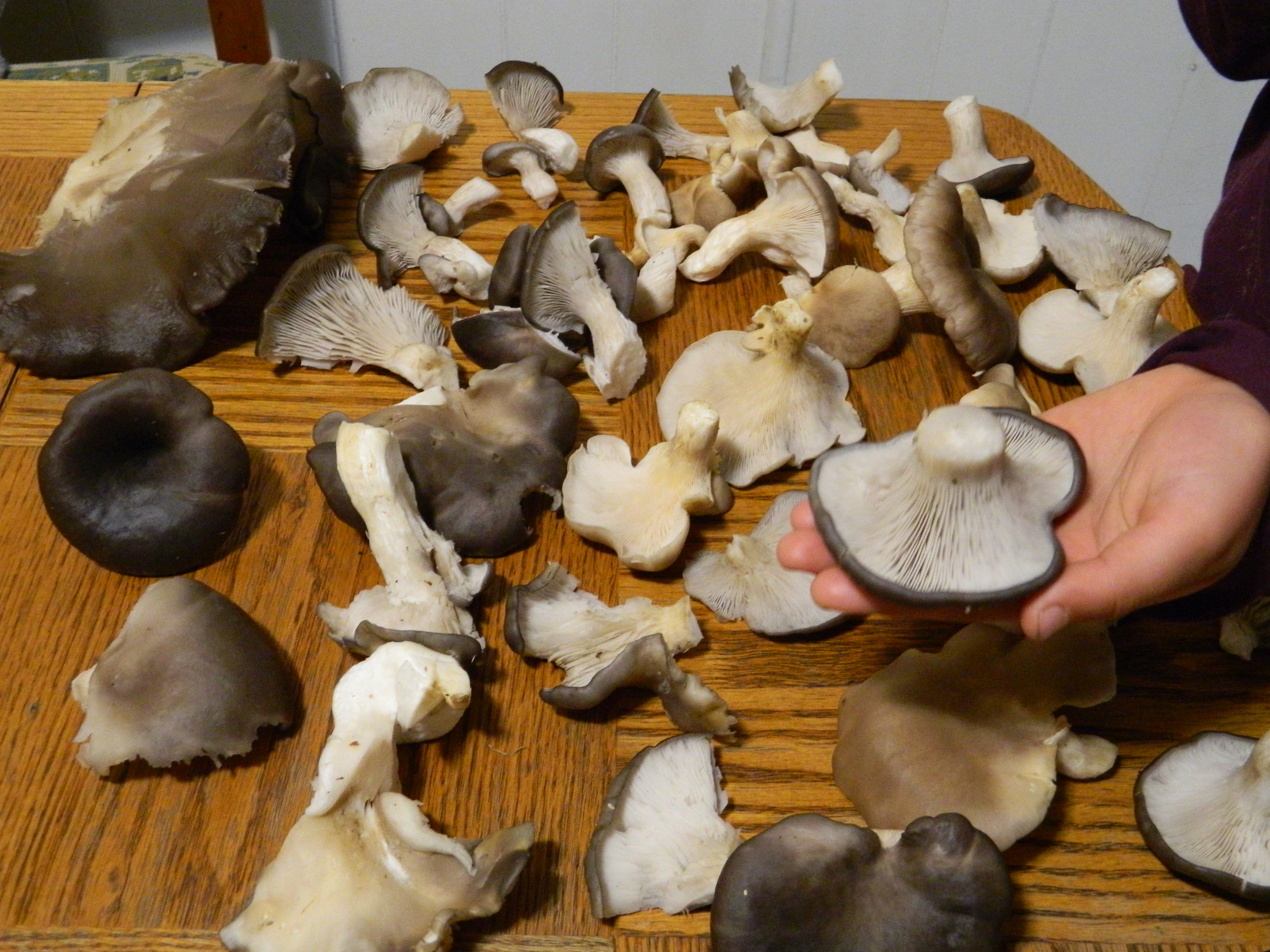
Recently my husband, Peter, took a grow-your-own-culinary-mushroom course with Brent Cox from Frosty Hollow Mushrooms. Since then, he has been slightly obsessed with growing mushrooms. We now have a patch of gourmet mushrooms growing in our forest. I love it! It is such a joy to watch the mushrooms grow from little nuggets to giant oysters.


Peter bought a bunch of mushroom compost from Lake Country Mushrooms and placed it in a shady spot in the forest and covered it up with hay. After the occasional watering we soon had the patch producing large, luscious patches of oyster mushrooms in varying colours. 

We are now eating mushrooms almost daily and we both cook and dry the mushrooms to preserve them for later. Countertops filled with mushrooms has become a common occurrence and the kids have been studying mushrooms as part of their homeschooling.


golden oyster mushrooms top
elm oyster mushrooms below


Brent talks about how mushrooms have the potential to grow abundantly in small places and that they can be a substitute for meat in a world where pressure on resources is higher. They can produce a large amount of food and contain beneficial minerals and vitamins. They also have that delicious umami flavour. 

Right now, Brent grows a variety of oyster mushrooms as well as chestnut mushrooms. He sells the mushrooms and the grow-your-own kits at various farmers' markets (Armstrong, Salmon Arm and Kamloops). Frosty Hollow Mushrooms also sell their mushrooms to various grocery stores in Salmon Arm. Brent remarks that it used to be harder to find gourmet mushrooms that were grown locally. Most of those mushrooms were imported from Asian markets before but now there are more and more small-scale, local farms growing a diverse range of mushrooms. 


oyster mushrooms growing on prepared grow your own kit- made from grain inoculated with mycelium


Brent is happy to share what he has learnt and is himself constantly seeking to learn more about this fascinating topic. There is so much more to learn about mushrooms, their importance in the ecosystem and how they can benefit humans. Brent plans to teach more courses on mushrooms this fall through the Armstrong Rec Centre. I’ll be sure to check out his courses. 


He also grows medicinal mushrooms such as red Reishi (Ganoderma lucidum or Ganoderma lingzhi) and Lion's mane (Hericium erinaceus). Brent explains that the Reishi contains many B-vitamins and can help with heart and cardiovascular health. The Lion's Mane is helpful for brain and cognitive health and it can relieve anxiety and depression. In the future Brent also wants to grow turkey tail (Trametes versicolor) and cordyceps for their medicinal properties. 


AIAO students- the Mycelium Mates

Not only are mushrooms beneficial as food and medicine, but they also provide a great service in the form of cleaning the environment and sharing nutrients with plants through their mycelium.

Recently I had a chance to speak with some students from Fulton's AIAO program in Vernon. They have been working hard over the last year to learn everything they can about mushrooms. Chatting with Aidan Spicer, Anna MacDuff, Jacob Adkins and Kayden Shaver is like talking with an encyclopedia in mushroom knowledge. They tell me intriguing facts about each fungus they have studied, and they comfortably name them by their common and Latin name. Their passion and interest are apparent. For their Care (Climate Action Ripple Effect) project they decided to focus on how mushrooms break down plastics. The students finish each other’s sentences as they explain the science behind how the mushrooms use enzymes to break down and externally ingest the plastic. You can tell that they have become used to sharing their knowledge and that they work well together presenting it. They have presented their findings at Okanagan Landing Elementary School, on Beach Radio, for the Vernon Naturalist club and they have another speaking engagement coming up at the Vernon Library.


They would like to take the project further and do a pilot study to see how mushrooms could work at the landfill. For example, mushrooms in the Pestalotiopsis genus work well in anaerobic environments such as landfills where dry, and oxygen poor conditions make it hard for things to break down. The students are now pondering which native species of mushroom might be suitable for a project like this and how to go about finding spores for it.


It is so exciting to think about all the ways that mushrooms can contribute to our lives. 
Both Brent and the AIAO students tell me that mushrooms can be used to make building material that are lightweight and completely sustainable. It blows my mind when I see structures made from mycelium bricks. Some of this knowledge have been known to mankind for a long time, it was already practised by the Incans. Here is a link to an article I found interesting by Environmental Planner and Housing Researcher, Maria Saxton: 

https://www.buildwithrise.com/stories/mycelium-fungi-as-a-building-material#:~:text=Mycelium%20is%20100%25%20organic%2C%20compostable,been%20used%20for%20packaging%20purposes.


Thank you for visiting my blog. I look forward to connecting with you in the future again.

With Kindness,

Mikaela


Tuesday, August 24, 2021

Interview with Jami Harding at Blue Mountain Plant Nursery


Conversations at the plant nursery with Jami Harding


    Speaking with Jami, her enthusiasm and knowledge of plants shines through. Currently she is working at Blue Mountain Nursery in Armstrong and has done so for the last seven years. Prior experience is in forestry and silviculture. Her broad experience of plants and trees gives her a unique lens for which to observe the cultivated versus the wild. Jami speaks of the plants as if they were dear friends. She looks at conditions from a plant's perspective when putting them in the yard and uses words more commonly heard when describing people to explain the plants' needs. When we get on the topic of soil and how a plant thrives she grins widely and states that a wild plant is a stronger, better adapted specimen due to the fungal helpers in the forest soil. She suggests putting a few logs on the ground in your garden to attract the microbial and fungal communities that will nurture your soil as they decompose. A well-manicured lawn will never be as rich in life and as healthy as a patch of wild forest. 


    “The benefits of growing native plants and plants suitable for the climate are that they are better for both fauna and the water-table”, Jami says and cites numerous scientific studies from a broad field to give effect to her words. She uses cautionary words and can see trouble ahead with regards to future water in the Okanagan. When people come to her for advice regarding their gardens she will steer them towards native plants that can handle less water. She points to the hills and says: “Those plants up there will always be more robust and stronger than a nursery plant. They are accustomed to the area. Besides, they will be lower maintenance in your yard once established”.

    She describes how a yard can be both productive in terms of food for you and your family as well as be aesthetically pleasing. “Mimic the way the forest grows but prune your bushes and fruit trees to make them accessible for picking”. She sincerely looks at me and states with confidence: “ We [humans] all know what to do to save the planet, we just choose not to! Grow your own food, keep the water clean and be frugal with it, nurture the soil and the insect community; we all know that we need to take care of our land.”


    We continue to discuss what is done on a regulatory level from regional and governmental bodies to ensure that new developments or riparian zones (next to waterways) get planted with at least a percentage of local native plants. Jami does not know of any regulations that state that homeowners or developers need to grow even a single, native plant. Home owners and orchards spray pesticides that end up in our waterways, who regulates that? Jami looks up from the plant she is tending, intently locks eyes with me and says: “Let's hope it doesn't take a crisis before we change our ways.”


    Let's heed Jami's advice and make our yards and gardens healthy places that will sustain the local fauna. According to studies done by the Provincial Ministry of the Environment, Central Okanagan Regional District and Environment Canada “Okanagan has become home to the largest concentration of rare, endangered and threatened species in BC.... and since 2002 Okanagan River is classified as one of Canada's most endangered rivers.”


    Each one of us has the power to remedy this by re-creating local habitat and choosing local plants over exotic ones. We can choose to not use poison/pesticides in our yards and gardens. We can use our water wisely, exchanging all or part of our lawns for drought hardy plants and avoiding washing our car in summer. We can influence others and we can put pressure on our governmental bodies that more is done to protect this bio-diverse and marvellous region. Let's follow Jami's advice and listen to her warnings. Let's not wait until it is too late!

Thursday, July 15, 2021

Purslane


Right now the purslane (Portulaca oleraceae) is thriving. I thought I'd share with you some of the info I have compiled on this remarkable plant. The fact that it can handle severe drought makes this a plant to pay attention to. We need to look into plants that need less water and that can handle heat and dry conditions since our future will probably have more heat waves in store for us.

Purslane (Portulaca oleraceae) Portulacaceae                                                                                   

Synonyms: Green Purslane, Little Hogweed, Verdolaga, Pursley, Red Root

Description: Annual herb that grows prostrate to the ground. It has fleshy hairless leaves that are paddle shaped. They are arranged in clusters/rosettes off the stem with smaller leaves overlapping larger ones. Stalk is thick and fleshy, sometimes with a reddish tint. Flowers are small and yellow with five petals that are notched at the top. They are formed at tips of branching stems. When they bloom they last for a few hours only. Here at the farm it is rare to see it flower. The presence of cleistogamous (petal-less, self-pollinating) flowers is a possible explanation for this phenomenon. Seed pod is smooth, oval and splits in half crosswise to form a little cup that holds the seeds for dispersal. Seeds are black, round and flattened. The root is a deep taproot.


Uses: We are able to harvest purslane from mid-summer until late fall where we are (North Okangan, BC). After we harvested some of our root crops the ground was left bare and the purslane took the moment to establish itself and spread out over the garden beds. It is doing us a great favour by holding the soil and retaining moisture. Besides it is one of the tastiest plants you will ever eat. I feel that we never get enough purslane in a year. All parts of it can be eaten. The succulent leaves and fleshy stalks are juicy and a little tart with a hint of salt. The sour flavour is stronger in the morning. We pick the entire aerial part of the plant and add it raw to salads and sandwiches. Sometimes the lower stalks can be a bit tough, if so, snip off your purslane greens a bit higher towards the tip and you should have no problem. I love adding purslane fresh to a potato salad. It gives a tangy little surprise that makes a potato salad more interesting and less heavy. It works really well in cold foods such as a quinoa salad and cold couscous salad. It mixes especially well in Greek yogurt and makes an interesting addition in a tzatziki dip. For a sweet treat the purslane leaves can be mixed with fruit and ice cubes and be whisked in the food processor for a delicious smoothie/slushy. Sometimes I add hemp seeds and frozen grated zucchini to my smoothies to make them extra nutritious and yummy.

    Purslane can also be used in cooking, it is mucilaginous so will thicken up soups and stews. Another fun way to use the stalks and leaves of this plant is to turn them into a refrigerator pickle. They do not hold up to regular canning processes so are best added fresh to a jar and covered with pickle brine. Set in fridge for three days to a week before opening. It is recommended that refrigerator pickles be consumed within a month. In our house there is no risk of them going bad. We gobble them up long before then.

    The seeds can be gathered and eaten too. Here we don't get enough purslane to make that worthwhile but I have read that in other parts of the world the seeds were ground up and made into seed cakes. I can clearly see it now, I need to deliberately cultivate more of this wonderful plant! 


Other uses: Purslane has been used for a very long time by various peoples all around the globe. The name oleracea means vegetable or herb in Latin. Some uses in Traditional Chinese Medicine dates back thousands of years. It has been used for headaches, fevers, intestinal worms, dysentery, eczema and diabetes to name just a few. Personally I like using the juice of it on a sunburn. It feels cooling and it soothes the damaged skin.

    This plant has a high amount of omega-3 which is not so common in green plants. We more often find omega-3 in fatty fish and nuts. Omega-3 has been found to have multiple benefits for the heart and the brain. Purslane is also a good source of vitamin A, iron and potassium.

    Purslane makes a great companion plant because it retains the moisture in the soil and its long and strong roots can penetrate the ground and allow other plants' roots to get further down into the ground and tap into water and minerals at a deeper depth.

    This plant can handle severe drought and is unusual in that it can utilize both C4 and CAM photosynthetic pathways. In the CAM process the plant keeps its stomata closed during the day to reduce water loss. It appears as if purslane switches to CAM (Crassulaceaen Acid Metabolism) after a period of extensive drought. Plants like these might be of crucial importance as our climate changes.

The seeds of the plant are popular with sparrows and songbirds.

Caution: Contains some oxalic acid which will lessen if cooked. If you have a history of kidney stones be cautious using this plant since it may increase such a condition.


Similar species/ Look-alikes:

Prostrate Spurge/Spotted Spurge (Euphorbia maculata/ Chamaesyce maculata) Native prostrate annual. Leaves are oval and grow in a flattened opposite pattern. They do not form the small rosette-like structures with small leaves overlapping large ones like purslane does. Often the leaves will have a darker spot on their top. Flower is white and seed pods have three ridges. Sparsely covered in hairs. It exudes a sticky milky latex that can cause skin irritation. Poisonous.

purslane (left), ridge-seed spurge (right)

Ridge-Seed Spurge (Euphorbia glyptosperma) Looks very similar to prostrate spurge apart from the lack of hairs and no red spot on top of leaf. There are also differences in fruits and seeds. E. glyptosperma has a smooth seed pod/fruit, whereas E. maculata has one that is covered in fine hairs. The seeds differ too, E. glyptosperma has clear transverse ridges. Flower is tiny, pink with with edges. The plant exudes a sticky milky latex that can cause skin irritation. Poisonous.

Common Knotweed (Polygonum arenastrum/Polygonum aviculare) Prostrate annual, sometimes perennial. Leaves are alternate and oval. They are not fleshy like purslane. At each leaf base a papery silver-coloured ochrea can be found. Flowers are green with pink-white edges. Edible.